
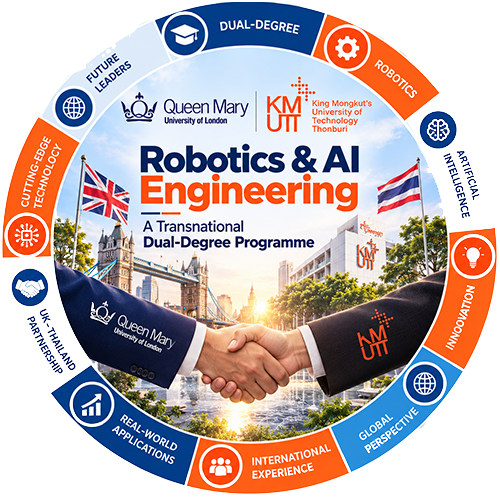

Robotics & AI Engineering — A Transnational Dual-Degree Programme
A four-year, 131-credit engineering programme delivered through a transnational collaboration between Queen Mary University of London (QMUL) and King Mongkut’s University of Technology Thonburi (KMUTT). The programme brings together robotics, artificial intelligence, engineering systems and related interdisciplinary study.
Robotics & AI Engineering is a transnational dual-degree programme delivered by Queen Mary University of London and King Mongkut’s University of Technology Thonburi (KMUTT).
The programme is designed as a 4-year engineering degree with a total of 131 credits.
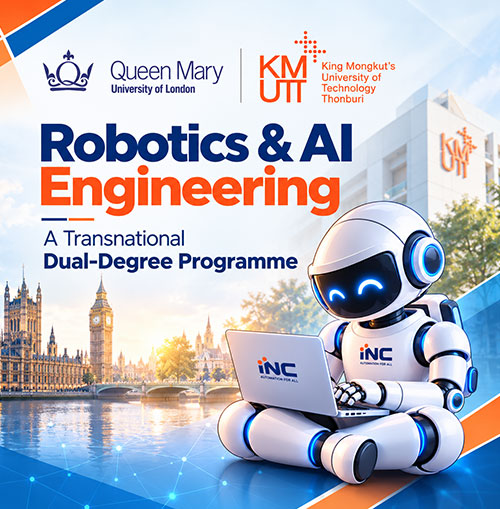
Students receive a KMUTT B.Eng. in Robotics and AI Engineering and a Queen Mary B.Eng. in Robotics and AI Engineering.
The programme combines the academic environments of both partner universities.
Degree Awards
Two partner universities deliver an international engineering education in Robotics & AI.
- ROBOTICS • ARTIFICIAL INTELLIGENCE • AUTOMATION • INTELLIGENT SYSTEMS
- ROBOTICS • ARTIFICIAL INTELLIGENCE • AUTOMATION • INTELLIGENT SYSTEMS
- ROBOTICS • ARTIFICIAL INTELLIGENCE • AUTOMATION • INTELLIGENT SYSTEMS


Build The Knowledge And Skills For The Future Of Intelligent Engineering
The programme brings together robotics, artificial intelligence and engineering systems in an international dual-degree learning environment.
-
 Robotics & Intelligent Systems
-
 Artificial Intelligence
-
 Engineering & Automation
-
 International Learning
-
 Industry Internship
-
 Dual-Degree Experience

Four Features That Define The Learning Experience

Russell Group Prestige
Queen Mary is a member of the UK Russell Group, bringing an internationally recognised academic environment to the programme.

Global Recognition
The programme source states that accreditation by the UK Engineering Council under the Washington Accord is subject to accreditation.

Flying Faculty
Queen Mary academics travel to Thailand to deliver core modules while integrating local KMUTT engineering expertise.

Industry Internship
The programme includes summer industrial training or short-term research connecting students with industrial and academic networks.
 PROGRAMME AT A GLANCE
131 Credits • 4 Years • 2 Degree Awards

131 Total Credits
The programme combines general education, specific engineering courses and free electives.
 4
4
Years Of Study
A four-year engineering pathway from foundations to capstone and mastery.
 2
2
Partner Universities
Queen Mary University of London and King Mongkut’s University of Technology Thonburi.
2 Degree Awards
KMUTT B.Eng. and Queen Mary B.Eng. in Robotics and AI Engineering.
From Engineering Foundations To Capstone Mastery
A progressive four-year engineering pathway that builds knowledge from foundations through robotics, artificial intelligence, industrial training and a final capstone project.

Year 1: Foundations (34 Credits)
Mathematics, Physics, Programming Fundamentals, Design Engineering, Professional Practice and English Language courses.

Year 2: Core Systems & AI (35 Credits)
Statistics, Electric Circuits, System Modelling, Object-Oriented Programming, Sensors, AI and Experimental Design.
Year 3: Specialization & Training (32 Credits)
Robotics Technologies, Machine Learning, Deep Learning, Control Systems, Signals, Data Science and summer industrial training.

Year 4: Capstone & Mastery (30 Credits)
Mechatronics, Robotic Systems, Human & Robot Interaction, Modelling & Control, electives and a year-long capstone project.
131 Credits Across Engineering, Computing, Robotics And AI
The source programme structure identifies 27 credits of General Education, 98 credits of Specific Courses and 6 credits of Free Electives.
General Education
27 credits
General education supporting broader academic development.
Specific Courses
98 credits
Basic Engineering 21 • Computing 6 • Robotics 42 • AI & Data 21 • Project-based Learning 8
Free Electives
6 credits
Space for elective study within the programme structure.
Develop Knowledge Across Robotics, AI And Intelligent Engineering
The source curriculum highlights computing and programming, artificial intelligence and data, robotics and automation, and project-based learning.
Computing & Programming
Programming Fundamentals and Object-Oriented Programming and Design.
AI & Data
Artificial Intelligence, Machine Learning, Deep Learning, Big Data Processing and AI Tools.
Robotics & Automation
Robotics Technologies, Mechatronics of Robots, Embedded AI, Human and Robot Interaction, and Control Systems Design.
Project-Based Learning
Industrial Training / Short-term Research and Future Technologies Projects 1 & 2.
Engineering The Future
With Robotics & AI
131 Credits • 4 Years • Dual-Award Programme
Queen Mary University of London × King Mongkut’s University of Technology Thonburi