The COSIN (COntrol Systems for INdustrial applications) Lab was founded by Dr. Benjamas Panomruttanarug in 2011, with a mission to advance practical control engineering — particularly tracking control — for industrial applications. Over the following decade, the lab's research interests gradually expanded toward autonomous driving, bridging classical control theory with modern AI-driven perception.
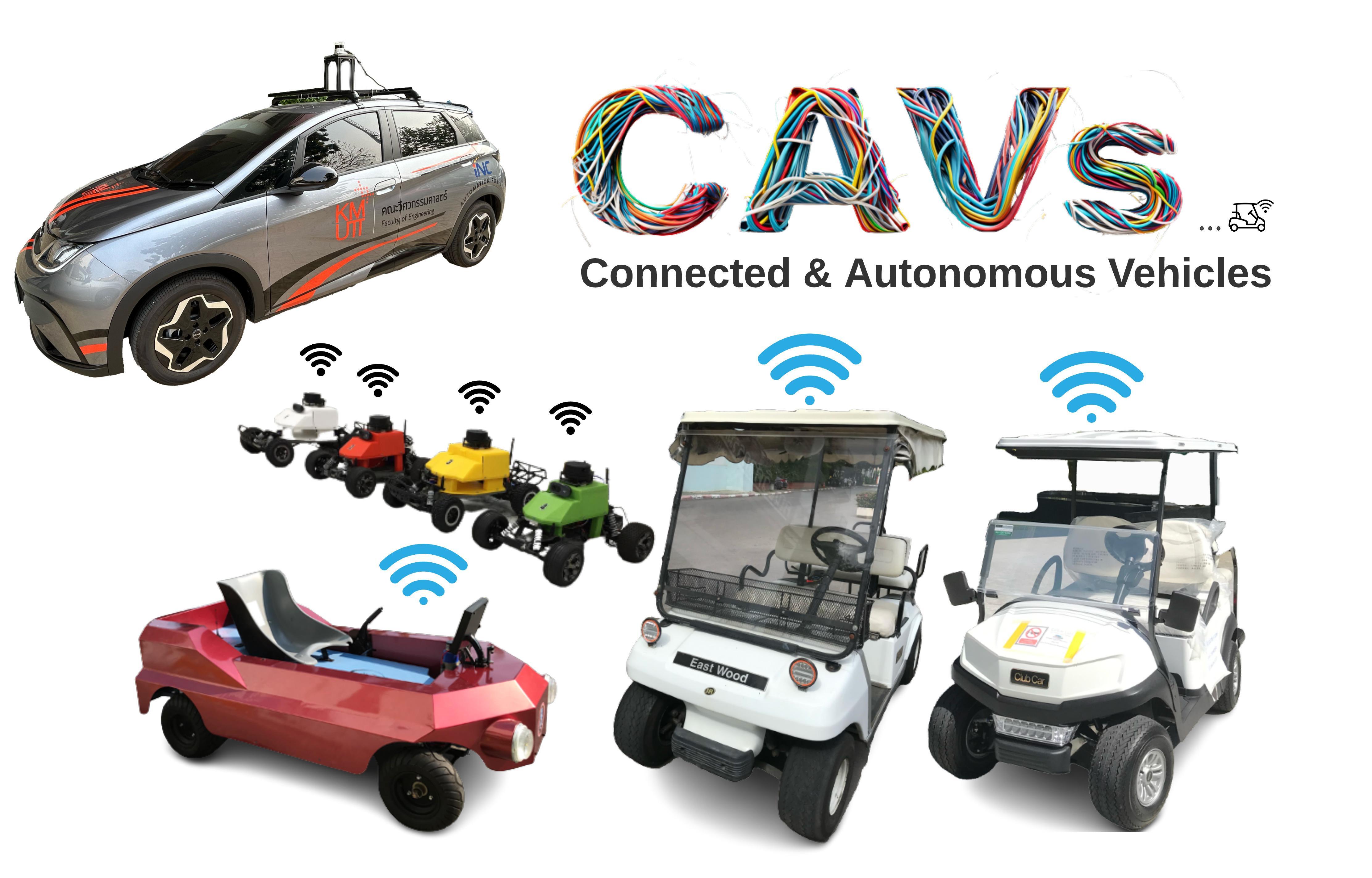
In 2024, with institutional funding from KMUTT, the team established the Connected and Autonomous Vehicles (CAVs) research group. The group operates a diverse fleet of platforms — including small-scale racing car robots, a go-kart, golf carts, and a full-size BYD electric vehicle — and develops robotic EV chargers aimed at commercial deployment. Our work spans participation in autonomous racing competitions, delivery of a multidisciplinary course on autonomous driving technology, and research on LiDAR-based 3D mapping and localization, 360° multi-camera surround perception, and motion planning and tracking control.
Autonomous golf cart
Voice AI agent with 3D map navigation — 2026
Our latest demonstration: the self-driving golf cart navigates by combining a Voice AI agent that accepts natural-language commands with a 3D LiDAR map used for real-time localization and path planning.
BYD EV platform
Full-size autonomous vehicle — 2025
A newly acquired BYD electric vehicle — the latest addition to the CAVs platform fleet. This full-size EV serves as the group's next-generation testbed, supporting our transition from research-scale platforms toward autonomous driving on a production-class electric vehicle.
Autonomous golf cart
LiDAR navigation with front-camera obstacle stop — 2025
The golf cart navigates autonomously using a 3D LiDAR map for localization and path planning, while a single front-facing camera detects obstacles ahead of the vehicle and triggers it to stop when necessary.
KUKA Robotic EV Charger
RealSense RGB-D charging — 2024
A KUKA manipulator performing autonomous EV charging using a RealSense camera — RGB to detect the vehicle inlet and depth to plan the charging trajectory with an AI technique.
Autonomous golf cart
LiDAR-based navigation — 2024
The golf cart driving autonomously on the KMUTT campus using LiDAR-based mapping, localization, and navigation.
Autonomous golf cart
Vision-based navigation — 2024
Vision-based lane and obstacle detection steering the golf cart through a real campus environment.
Autonomous go-kart
Road tracking with semantic segmentation — 2023
Road tracking on the go-kart using a RealSense camera and ENet semantic segmentation to extract the drivable surface, with Iterative Learning Control (ILC) ensuring robustness in shaded areas.
F1Tenth platform
Scaled autonomous racing — 2023
An F1Tenth-scale autonomous racing car used as a research testbed for high-speed planning and tracking control experiments.
Robotic EV Charger
Halcon-based vision — 2023
An early robotic EV charger using MVTec Halcon machine vision to localize the vehicle inlet and plan a collision-free approach for the manipulator.
Autonomous golf cart
GNSS-based navigation — 2022
GNSS-based outdoor waypoint navigation on the golf cart platform, demonstrating reliable path tracking around the KMUTT campus.
INC Racing 2020
In-house autonomous racing competition — 2020
The first INC Racing competition organized for KMUTT students, giving them hands-on experience designing and tuning end-to-end self-driving algorithms.
Autonomous golf cart
Autonomous speed control — 2020
Autonomous speed regulation on the golf cart using a PID controller, with experimental results benchmarked against commercial cruise control systems.
Autonomous go-kart
GNSS-based outdoor navigation — 2019
An autonomous go-kart following outdoor waypoints using GNSS positioning — the lab's first step from small racing robots toward full-scale autonomous vehicles.
IARRC 2018
Vision-based autonomous racing — 2018
Returning to the International Autonomous Robot Racing Competition with improved vision-based lane following and obstacle avoidance on a small-scale racing platform.
IARRC 2017
International Autonomous Robot Racing Competition — 2017
Our undergraduate team's debut at the International Autonomous Robot Racing Competition (IARRC), marking the lab's first international autonomous racing experience.